Key and copyright.(In Czech)
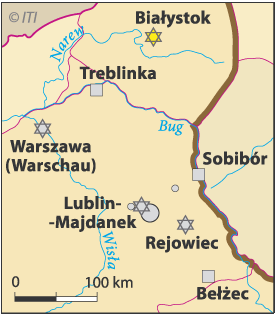
Białystok is a town in north-eastern Poland which once had a large Jewish population. Between the two world wars, Jews comprised over half the population and owned approximately three quarters of Białystok's textile industry.
The town was initially captured by the German army on the 15th of September 1939, but a week later it was handed over to the Soviet Union. It was then retaken by the Germans during the offensive against the Soviet Union on the 27th of July 1941. During the first days of occupation, Einsatzgruppen (link in Czech) units murdered several thousand Jews, as well as members of the intelligentsia, communists and political activists.
Białystok's Jews were forced to create a Judenrat
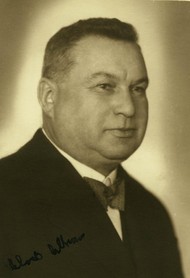
(Jewish council). Efraim Barasz, until then the head of the Jewish community, was appointed its head. From the 1st of August onwards, 50 000 Jewish inhabitants were forced to move into the confined space of the newly-established ghetto. The Białystok ghetto was rapidly transformed into an industrial centre supplying products for the occupying authorities, with around ten factories and a large number of workshops. The ghetto also secretly made products for its own inhabitants, and there was a flourishing trade in all kinds of goods, but this was banned by the German authorities in mid-1942.
Food rations in the ghetto were totally insufficient, and their supply was irregular. The Judenrat
thus supported the creation of small gardens. Several kitchens were organised within the ghetto, there were two hospitals and other healthcare facilities, two schools, a court and other institutions. Order within the ghetto was overseen by the 200-men-strong Jewish Public Order Service.
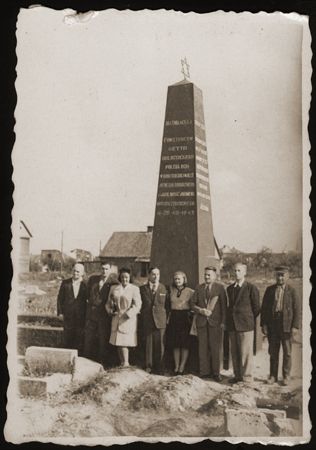
A group of former prisoners of the ghetto in front of the memorial for Jewish victims, 1945 - 1947. (Foto: Meir Orkin, courtesy of USHMM Photo Archives)
In September and October 1941, 4 500 Jews, above all the sick, unskilled and unemployed, were moved from the Białystok ghetto to the ghetto in Prużana. Most of them were murdered when the Prużana ghetto was liquidated in January 1943.
Gradually, the various political
Jewish organisations in the ghetto formed themselves into a resistance organisation that collected documents about the ghetto and started to plan an armed uprising. In February 1943, an operation
was carried out in the ghetto during which two thousand Jews were shot on the spot, and around 10 000 were deported to Treblinka. Nevertheless, Barasz tried to ensure the ghetto's continuing existence and thus protect some of its inhabitants, but in August 1943 the ghetto was liquidated under the leadership of Odilo Globocnik. The armed resistance groups rebelled against the evacuation
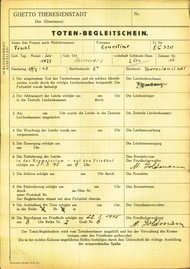
, and for five days (16th-20th of August) they managed to hold out, although outnumbered by Germans. Some of the Białystok Jews were deported to Treblinka, where they were murdered immediately, while others were taken to Majdanek, where they were subjected to selection. A train with 1 200 children was taken to Terezín, but only a few weeks later these children were taken to Auschwitz and murdered.
Some of the Białystok resistance members had earlier managed to escape and join the partisans. Approximately 200 Jews from Białystok survived the German camps, and several dozen managed to go into hiding and survive in the Aryan
part of the town. Around 60 Jewish partisans also managed to survive. Białystok was liberated by the Red Army in August 1944.
-
Links:
-
Literature:
-
Mielnicki, Michel. Bialystok to Birkenau. Vancouver: Ronsdale Press, 2000. 247 s.
-
Midler, Benjamin. The life of a child survivor from Bialystock, Poland. B. Midler, 1999. 142 s.
-
The Biastolyker memorial book (Das Bialystoker Gedenkbuch). New York: Biastolyker Center, 1982.
 Print
Print